 English
 Indian
 العربية
 Español
 Deutsch
 Türkçe
 Русский
 Français (Afrique)

Is Prem rugby union turning into basketball? Nailbiters supply case for defence
Record try-glut in round one suggested all-out attack is en vogue, but maybe you can defend well and still concede tries in the modern game? sportbet.reviews
After one weekend of the Prem season the feeling was we had crossed the Rubicon. A remarkable 52 tries, eclipsing the previous record for round one despite the fact that fewer matches were played added further weight to the argument – a criticism and a compliment – that the English club game is creeping closer towards a form of basketball.
Then came round two and 41 tries. A sizeable number, certainly compared with seasons of yesteryear, but equally giving a sense that defences had their day in some cases. Sale’s gritty victory over Saracens was a dogfight, Leicester’s win over Newcastle wasn’t pretty and while Bristol ran in six tries against Northampton, their success owed everything to defensive steel.
Continue reading...Dragon Age: The Veilguard failed because EA demanded yearly releases from BioWare, says former lead
It's a real pity what's become of Dragon Age. Once a pillar of BioWare alongside Mass Effect, the series is now in the nether regions of the zeitgeist, thanks in no small part to the commercial failure of Dragon Age: The Veilguard. The long-gestating sequel suffered a number of issues, and one of the central creators behind the whole franchise suggests a few reasons as to why.
In a new YouTube video (below), Mark Darrah, a lead developer across every installment of the fantasy RPG series (who announced his departure from BioWare in late 2020), broke down why and how The Veilguard wound up failing. Right off the top, he points toward stretched senior staff.
"The project ran without its most senior leadership when I was on Anthem, from 2017 until 2019," he explains. Next, then, were a number of delays, where the goalposts weren't moved far enough away to adequately get the game into a shippable state.
"The game spent a lot of time really close to its perceived release date," Darrah says. "The game changed release dates a lot of times, and the consequence of that is that the team always was quite close to its current release date."
Despite Dragon Age 4 "slipping a tonne," the deadline was always pushed in "little steps" rather than given considerable room to breathe. This created a situation where the team couldn't take an eagle's eye view of the project.
"There was never a time when the project was way in the future," Darrah recalls, "and things could be brought back, looked back, burned down, and looked at in a brand new light."
These issues sprang from, and were exacerbated by, the need for BioWare to fit into EA's annualization approach. Essentially, EA wanted to publish something from the studio every year. When your remit is chunky role-playing games, you can see how this would be difficult.
At one point, he says, BioWare's slate had Dragon Age: Inquisition, Mass Effect: Andromeda, Anthem, and Dragon Age 4 coming out yearly from 2013 onward. This didn't happen, and delays on each formed a domino effect that led, in part, to The Veilguard arriving in late 2024, to a muted response.
Now the future's uncertain for the studio and the series. Mass Effect 5 is apparently happening, but we've heard next to nothing for years now. Hopefully one day we see Dragon Age make a roaring return – just don't expect it any time soon.
25 years after Burnout, Star Wars: Galactic Racer boss says "we are asking way more" from players
Star Wars: Galactic Racer studio lead Matt Webster says the new roguelite racer is way more complex than other racers by the same team.
Star Wars: Galactic Racer is out now, and finally brings the series back to racing after a 24 year gap since the PS2's Racer Revenge. And perhaps more crucially, it's developed by the team at Fuse Games, which was born from multiple members of Criterion Games, making Galactic Racer as much of a homage to Star Wars: Episode 1 Racer as it is to Burnout 3 and Burnout Revenge.
And while working with a well known and mostly family-friendly IP like Star Wars could've led the devs to perhaps tone things down a little, Galactic Racer is pretty tough. You're moving at super high speeds and even brushing a wall can cause your speeder to blow up. And in the game's campaign, you only have three chances to blow up before you're eliminated and need to restart a run.
Talking to GamesRadar+ guides editor Will Sawyer – who also wrote our Star Wars: Galactic Racer review – Fuse Games CEO Webster spoke about the complexity of the racer, saying, "One of the things that's really interesting for me is that modern gamers can manage a greater amount of cognitive load."
He explains, "We are asking way more out of players in this game than I think we've ever done in a racing game with multiple boost things, pressing more than one face button at a time, switching up the abilities, and thinking strategically and tactically at the same time whilst traveling at 700 kilometers an hour and your eyes are on stalks. It's quite amazing."
Naturally, Galactic Racer has gone down a treat with many, becoming one of the highest-rated Star Wars games ever, and that's undoubtedly down to the racing pedigree of Fuse Games… and Ben Quadinaros, obviously.
Volatiles takes the piece-by-piece map building of boardgames like Betrayal at House on the Hill and slaps a gory survival shooter on top of them
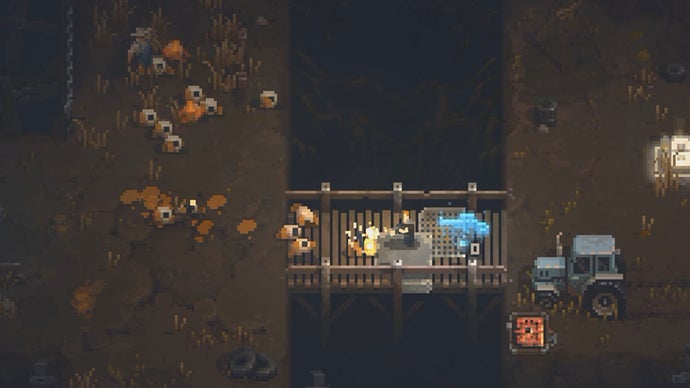
I do love a boardgame where you reveal the tiles as you play. Sure, I also enjoy turning over all the pieces at the beginning of a game of Settlers of Catan and taking in all the tiles and trying to work out a strategy based on which resources are clustered near which port, but that's not the same as a game like Betrayal at House on the Hill, where you all start together in one single room and unveil the architecture of the house tile by tile as you explore. You have that same strategic eye, looking at the function and threat each room holds, but because the house is still being built, your plan can't become fixed. You have to reassess the layout of the building with each new piece and, of course, when you hit the moment in the game where one player betrays you the real danger arrives, all that planning now has to be twisted to oppose the new threat.
Volatiles is an action game that plays with that same sense of strategy and mystery. It starts with you waking in a strange facility with little sense of what brought you there. The scientists around you say they're helping you, but they're the same people who keep dunking you into a sensory deprivation tank and forcing you to fight the monsters in your mind.
It's just possible they don't have your best interests at heart.