 English
 Español
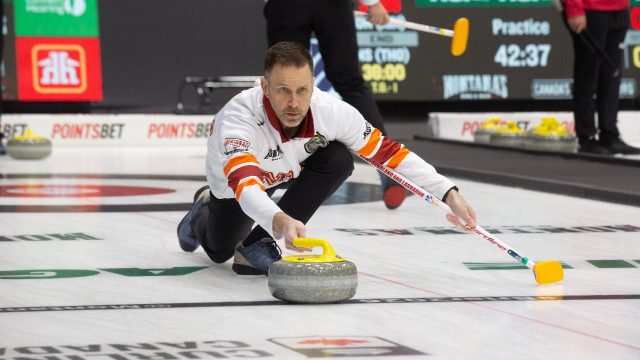
ST. JOHN’S, N.L. — It has been just 10 days since Marc Kennedy won Olympic gold in Cortina, and the third and his Team Canada have already rattled off five straight wins since then.
In other words, Kennedy, skipper Brad Jacobs, Brett Gallant and Ben Hebert barely had time to catch their breath after winning in Italy before they headed to Newfoundland to try to defend their national title at the Brier.
Still, a tired but recharging Team Canada is a perfect 5-0 here so far, their latest win coming on Tuesday afternoon at Mary Brown’s Centre, an 8-4 victory over Team Quebec in front of an appreciative crowd of 6,116 fans.
Kennedy, 44, is competing in his 14th Brier, and he’s a four-time national champion and two-time Olympic gold medallist. Not long after he walked off the pebbled ice following his latest win, Kennedy caught up with Sportsnet to talk about everything from that incredible run in Italy and the double-touch controversy he sparked on the ice, to his future in the sport and whether he’s considering four more years (his answer to that last one was very short and definite).
-
-
Montana’s Brier 2026
Keep up with the latest at the Canadian men’s curling championship as action gets underway in St. John’s, N.L.

Sportsnet: What has life been like since the Olympics? You’re already here competing again, and it must feel like an absolute whirlwind…
Kennedy: Yeah, an overwhelming amount of emotion for what happened, and trying to regain some energy to get here. But we’re getting a little better every day and it almost feels nice to be out on the ice with the guys again. Just excited, exhausted, tired, having fun out there — you name it, the emotion’s been felt.
How full is your energy tank right now?
Kennedy: At the start of the week, I would have said it was about five per cent, but I’d say we’re getting up to around 50 or 60. The schedule has worked good for us, one game a day, lots of rest. Our chiro is here with us, so we’re doing all the right things to try to fill the tank for what is sure to be some tough games coming up.
How many beers were consumed in the 48 hours after your team won Olympic gold?
Zero by me, because I don’t drink anymore — it’s been almost a decade. But the boys had their share of fun after, and it was well deserved (laughs).
How much sleep did you get that night?
Oh, not much. The most sleep I got was on the plane on the way home. We were home for 48 hours. I’ve had more sleep here this week than I did that whole two weeks in Italy.
Does it feel like your team is rolling here, like the momentum could keep you going to earn another chance to represent Canada? (The winner of the Brier competes at world championships later this month).
Yeah, it could… The emotional tank and the energy tank needs to refill a little bit, but we’re still throwing the rock well, we’re still making lots of shots. So, yeah, who knows. I think the longer this week goes, the more excited we are to try to give it another run.
Since you put this team together (in April of 2024), have you checked every box you could’ve imagined?
Yeah, I think we did. Which is crazy to say, right? You set really high goals and you’re not sure if you’re ever going to reach them, and we did. So, that was some of our conversation after (winning Olympic gold). We just kept looking at each other and saying, ‘Wow, we actually did it. We did everything we said that we were going to do.’ And we improved in all the areas we wanted to improve. We all did our jobs really, really well, and Brad was the best player there for most of the week. That made a big difference.
When that double-touch controversy was going on in Milan, how did you and the team manage to drown out all the noise it could have caused?
Getting off social media for the week was important for me. Really surrounding myself with great people, great teammates, my family, people that love you and want to see you succeed, was the secret. And, you know, there’s a lot about it that wasn’t great, but it made us a better team. In the moment, we had each other’s backs, we were fired up, we were excited and we almost recommitted to the job that we were there to do. And so it just gave everybody that much more motivation and emotion to go out there and do what we had to do. So, for all the bad that came from it, the good was that we were a better team and at the end of the day it may have helped us win a gold medal.
Did you find any humour in the many memes the controversy sparked?
Yeah, eventually I did. When my daughters were sending them to me, some of them were pretty funny. Knocking over the figure skaters was pretty funny.
What did you learn about this team in Cortina that you’re using to your advantage here at the Brier?
Oh, man. I just think we had to show how resilient we were. Like, were we mentally tough enough to deal with what happened. And for everyone to show up the way they did after that, for nobody to break, and for the whole support team, you know, (Team Canada coach) Jeff Stoughton, (Curling Canada’s high-performance director) Dave Murdoch, (Team Jacobs coach) Paul Webster, everyone that was in our inner circle, to rise to the occasion the way they did after that was really impressive. And I said when we won, I’ve never been happier for the people around me for what they accomplished amidst all the stuff that happened.
We learned a lot about one another, we learned a lot about how much we care about one another, what that meant to everybody. And again, it just made us really, really close. It goes from being a really close team to almost a close family when you go through an experience like what we just did. We’re forever bonded by that couple of weeks, and couldn’t be happier.
Around that double-touch controversy, I’ve heard many people in curling explain what was happening on the ice. How do you explain it?
I can’t do that yet. And I won’t do that yet. I think there’ll be a time and place for more clarity and more conversation. To be honest, coming straight here, we’ve never really had the opportunity to have those discussions about what happened. So, we’ll have to cross that bridge another day.
You headed from that emotionally charged event almost straight here. What is it like being in Newfoundland for Brad Gushue’s finale in his hometown, with all the emotion around it?
I think it’s the best place to be. The crowd’s been terrific. They’ve been terrific to us, which we’ve appreciated. We have been booed in this building before, so to have them cheering for us and being very Canadian and probably still wanting us not to win, but at the end of the day to feel their respect and appreciation, is awesome. And Brad (Gushue) has earned what he’s getting this week, which is, you know, standing ovations and cheers and celebrations. I mean, let’s celebrate one of the greatest curling careers of all time. To have a first-person view of it is pretty exciting and special, and it’ll only get better as the week goes on.
What can you tell us about the future of your career?
We’re not done yet — that’s all I can tell you. We’ve started to have some of those conversations this week as to what that looks like, so still more conversations to come and more details. But I don’t think you can expect any retirement announcements soon from our team.
You won Olympic gold in 2010, and again in 2026. How different did it feel this time around, as the oldest member of Team Canada at the Olympics, not to dwell on that…
We’re not meant to be playing sports at this high a level, I guess (laughs). It had a lot of emotion — it felt different. You know, the same feeling of appreciation for your teammates and the journey that you went on, but just being older gives a different perspective. Being outside of Canada was a different perspective (compared to winning in Vancouver in 2010), having our families there, having my teenage daughters there was… You know, that was the benefit of being an older Olympian was I was one of the rare athletes there that had teenage daughters that would really remember everything from start to finish, good and bad. To celebrate with them after was a huge amount of relief and emotion and joy and excitement.
I think when I won it the first time, to be honest, you’re a little naïve. You just think, ‘Oh, this is going to be one of many.’ You don’t realize how hard it is to get there. And listen, the quality of teams this time around is, it’s not even comparable with how good these teams are and how well we had to play and how much better we had to get in order to compete for gold. So this one was much, much more difficult. This one was extremely special.
So…maybe four more years of curling so you can give it another shot, then?
No (laughs). No.